 Coco
CocoFormat Coconut Tier List: All 18 Coconuts Ranked, August 2026
Format Coconut is a multiplayer variant of Disney Lorcana, in open beta since July 2026. Three or four players race to 25 lore. Decks are singleton, one copy of each card, with a single exception: you pick one of 18 coconuts, which gives you a passive ability for the whole game and lets you run up to four copies of one named card. A deck can run up to three inks, and the coconut’s ink has to be one of them.
Every coconut text quoted below was checked against the official app as of August 27, 2026. The beta gets tweaked on a weekly rhythm, so the date on this page is doing real work.
Read this before the list
This is a personal exercise, done for fun. Format Coconut has no competitive circuit and no tournament results, so there is no meta here to read. What follows is what one person concluded after building all 18 decks, and it does not claim to be more than that.
The grades came out of deckbuilding. Each of the 18 lists was built card by card against the full pool, with the odds calculated wherever odds decide something. No games were played. Not one conclusion on this page came from a real table. That is the largest weakness in the whole exercise, and it should sit next to everything below while you read it.
So if you have been playing pods and your results disagree with a grade, your table beats my spreadsheet. The list carries a date because it exists to be contested.
Building all 18 was the best part
The ranking is the byproduct. The reason this project took over my summer is that Format Coconut turns out to be a fascinating deckbuilding puzzle, and building 18 decks back to back surfaced things that building one or two never would.
Singleton removes the tool you normally reach for. You cannot build consistency by adding copies, so you build it by adding cards that do approximately the same job, and every deck becomes a question about how many near duplicates of an effect the pool actually contains. Some coconuts have twenty answers to that question and some have four. That gap explains more of this tier list than the ability texts do.
It was also the fastest way I have found to learn the Lorcana card pool properly. Eighteen decks means eighteen full sweeps through every ink, each one looking for something different, and cards I had read past a dozen times turned out to be exactly what some coconut wanted. A good part of this project was simply finding out what is actually printed, and the census numbers scattered through the grades below are the byproduct of that.
The other thing that reframed everything was what three opponents do to a game plan. In a duel one player is trying to slow you down. Here three are, and they never have to coordinate to be effective, because the removal and the pings and the lore drains all land on your board whether or not anybody planned it that way. A deck that scores steadily hands the table a dozen small windows to interfere with it. A deck that jumps from 12 lore to 25 in a single turn hands them almost none. That is most of why burst is priced so high in this format. The two decks at the top of this list dodge the same problem from the other direction, by getting far enough ahead early that the interference shows up too late to matter.
Starting next week I am publishing one deck per week, with the full list, the reasoning behind each ink and the math where math was involved, so the grades below can be checked instead of trusted.
How the grades were made
Every deck went through the same questions. Most of the weight landed on how big its best realistic turn is and how often that turn actually happens. After that came how far the deck can reach across the table and how quickly it closes, with resilience as the tiebreaker between decks that came out level. The grades reflect the decks I could actually build, and not how the abilities read on paper.
The pattern that matters more than the ranking
Building all 18 turned up something more interesting than the order they finished in. Across the whole set, without an exception I would defend, the decks with the biggest explosive turn are the least reliable ones, and the decks that do the same thing every game have no explosive turn in them. Nobody gets to buy both.
Snow White sits at one end. Her deck produces the largest single turn in the format and needs the hardest condition in the format to produce it. Winnie the Pooh sits at the other. His deck almost never stumbles and almost never spikes. Everything else lands somewhere along that line.
That looks deliberate, and in a format this young it is a good sign about the design. It also explains why the top of this list is nowhere near the biggest turns. Mickey Mouse and Stitch grade S because they are fast and repeatable, and in a race to 25 lore the deck that starts scoring first tends to arrive before anyone’s ceiling gets to matter.
If you take one thing from this post, take that trade rather than the ranking. The ranking is my opinion. The trade is a property of the format.
The tier list
Here it is in one image, with every grade explained underneath.
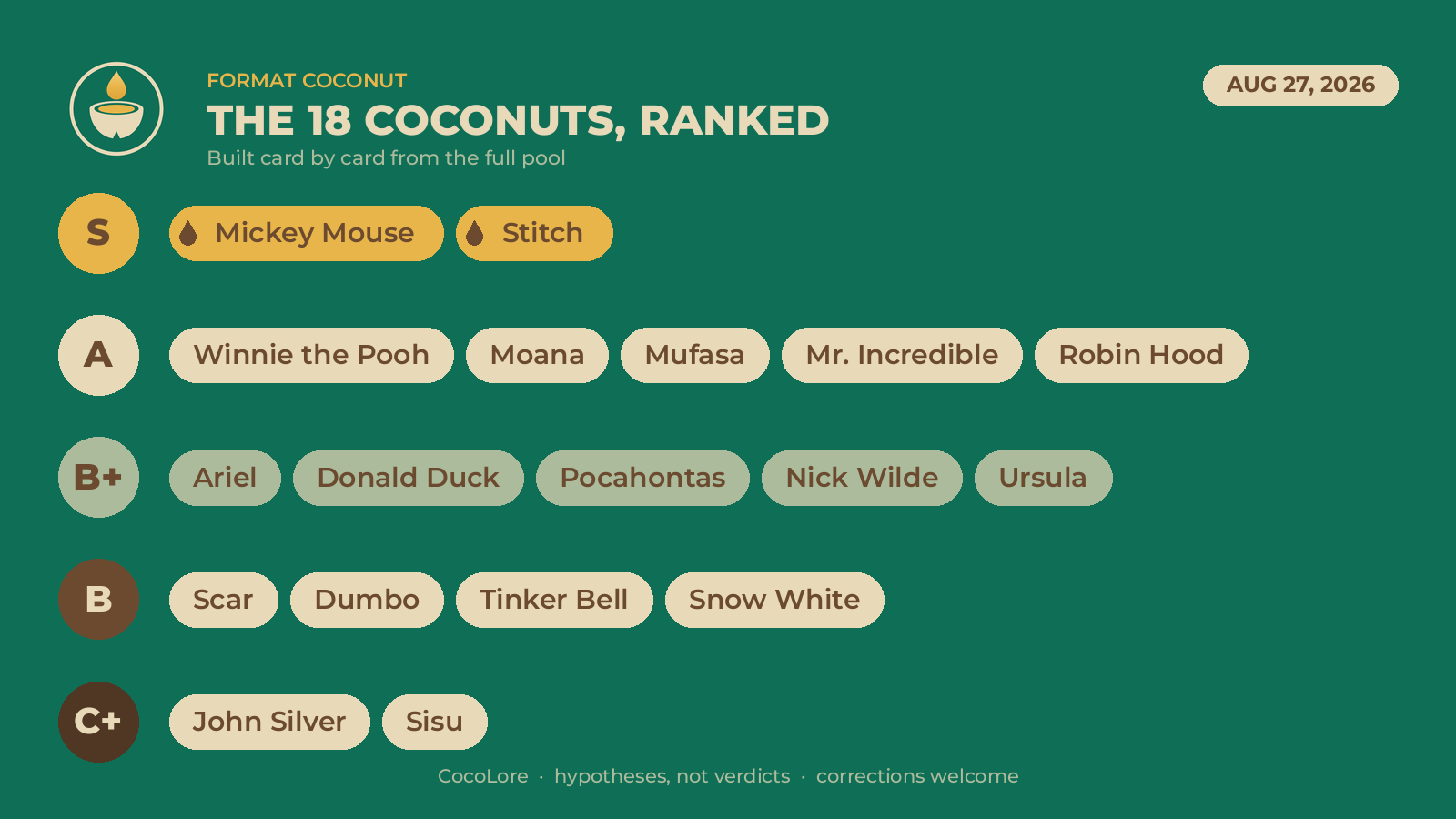
S tier
Mickey Mouse. Mickey Mouse character cards in your hand, deck and discard gain Shift 2. The pool is deep enough that the list ends up holding 23 Mickey cards, so what the coconut hands you is a category rather than a key piece. There is no single body worth removing and no card you need to find.
The deck plays like a conveyor belt. Each turn you shift a large Mickey onto the cheap one you played last turn, and Shift inherits the body’s state, so the new Mickey quests the moment it lands. The clearest example is Mickey Mouse — Brave Little Tailor, an 8-cost Evasive body that quests for 4, arriving on turn four or five for 2 ink. Nothing else in the format applies pressure this early: a 4-lore quest by turn four in roughly 78% of games. The weak point is quieter than it looks, since the cheap bases have to survive a turn on the table before the shift, and a table full of small pings can starve the supply line.
Stitch. Once during your turn you may play a character costing 2 or less for free, and if that character is named Lilo or Stitch, a chosen character gets +1 lore for the turn. The pool cooperates unusually well here: of the 26 different Lilo and Stitch cards printed, 13 cost 2 or less, so the bonus clause is live most turns rather than occasionally. Two bodies hit the table from turn one, lore starts on turn two, and the games I modeled finish around turn seven or eight, the quickest in the field after Mickey.
The free body becomes a free card once Stitch — Rock Star is down, since he lets you exert each cheap character you play to draw. Underneath that sits the deepest hand attack in the format, and all of it hits three people at once. Hypnotize and You Have Forgotten Me make every opponent discard, Bucky — Squirrel Squeak Tutor turns each of your Shifts into a table-wide discard, and Prince John — Greediest of All draws you a card for every card the table throws away. The catch is that your free play has to come from hand, so the archetype you are best at is also the archetype you are most exposed to.
He is the most arguable name in this tier. His coconut was changed on August 14 and he still grades here on speed alone, which is a lot of weight to put on modeled turns that no table has checked. If one grade up here is wrong, this is the one.
A tier
Winnie the Pooh. Whenever you play a character without an ability, you may pay 1 ink to draw a card. Plain bodies turn into cantrips, and the pool has 277 characters with no ability text on them, which is the largest enabler pool any coconut gets by a wide margin. The finished list carries 33 of them. No individual card is required for the deck to work, and the named card is a plain 5-cost body the plan does not lean on at all.
What makes this one strange to build is that the deckbuilding rule inverts. Everywhere else you hunt for text, and here you hunt for good stats with nothing written underneath. The interaction slots are filled entirely with symmetric effects, the kind that hit everyone equally, so three opponents watch you draw cards all game and never quite feel targeted. Nothing in the 18 is this hard to disrupt. It also has no turn that ends a game, which is the trade described above showing up in its purest form.
Moana. During your turn, if you have a Moana, Heihei or Pua character in play, you may ink an additional card. The condition is the good part. There are 19 different Moana, Heihei and Pua characters in the pool, spread across every ink and down to 1 cost, so the enabler is a category you can build density into rather than a card you have to draw.
Extra ink every turn is strong on its own, and the named card is what makes it free. Moana — Curious Explorer lets you ink cards from your discard, so the second ink per turn stops eating your hand and starts consuming cards you had already spent. The result is the most balanced deck of the 18, with no weak spot I could find anywhere on it. One caveat worth stating plainly: this evaluation is the oldest in the set, so of all 18 grades it is the likeliest to have drifted out of date without me noticing.
Mufasa. Once during your turn you may pay 5 ink to put the top 2 cards of your deck into your inkwell. The payoff is Mufasa — Ruler of Pride Rock, who readies your entire inkwell when he quests, so the best turns spend the same ink twice and a settled turn nine produces around 21 lore.
This deck taught me the most useful thing I learned all summer, and it is a negative result. Before building it I swept the pool for activated abilities that take ink and give back lore, expecting to find a mana sink to point all that ramp at. There are nine, and every one of them is limited to once per turn by the exert symbol. Lorcana has no card that converts unlimited ink into unlimited lore. Ramp has a hard ceiling of usefulness, and past it the extra ink is dead.
So the deck spends ink on cards instead of on activations, and the list is built out of expensive characters with high lore rather than engines, which the pool supports easily at 53 candidates in Sapphire and Emerald alone. No individual one of them is required. The finisher is the exception and the reason the grade stops here. He costs 8, cannot be inked, and the pool has nothing that searches him out, so the ceiling is gated behind drawing one specific expensive card at the right time.
Mr. Incredible. Whenever you play a Super character, they gain Rush for the turn and you may exert an opposing character with less strength. Every Super you cast becomes a challenge that resolves the moment it arrives, and the deck is built to charge rent on those challenges. Shere Khan — Menacing Predator pays lore whenever one of your characters challenges, and Mushu — Majestic Dragon hands out Resist +2 while challenging, which turns even the bad attacks into trades you win.
The big turn is Hero Work, a 2-cost action that makes your Heroes drain 1 lore from each opponent per challenge, and nearly every Super in the deck is also a Hero. It also gets the most comfortable seat in the format, because attacking whoever is winning is the kind of aggression the rest of the table endorses instead of resenting. What keeps it here is arithmetic. The list holds seven cards that charge the table for what your Supers are doing, one copy of each, and the turns that actually swing a game need two of those seven in play at once alongside a way to attack repeatedly. Two payoffs land together by turn seven in most games. All three pieces show up in about half.
Robin Hood. At the start of your first turn you put Robin’s Bow into play from your collection for free, which happens in 100% of games, and every character named Robin Hood you play afterwards deals 1 damage to a target of your choice. Fifteen Robin Hood cards make the list, so the trigger fires all game.
The two halves talk to each other more than they look like they do. Robin’s Bow readies whenever one of your Robin Hoods quests, so a single quest can turn into two more pings, and Robin Hood — Sneaky Sleuth quests for 1 plus 1 for each damaged opposing character in play, which is a number your own coconut has been raising since turn one. Shift him onto a cheaper Robin and the deck cashes in every arrow it fired.
The counting problem this creates is where the deck gets interesting. Sneaky Sleuth reads the whole table, so the fastest way to raise the number is to hit everybody at once instead of firing one arrow at a time. Chief Bogo — Respected Officer deals 1 damage to each opposing character every time you play a Floodborn character, which in a deck full of Shift targets goes off repeatedly, and Tinker Bell — Giant Fairy wounds all three boards the turn she lands and then keeps dealing 2 more whenever she banishes something in a challenge. One of those resolving before the Sleuth quest is usually worth more than three pings. What holds him back is that the ping is single target, so it is worth exactly as much at a two-player table as at a four-player one, in a format where the effects that touch each opponent get paid three times over.
B+ tier
Ariel. Whenever a Princess character of yours sings a song, you gain lore equal to her lore value. There is a subtlety here that shapes the whole deck. Singing exerts the character, which is what questing does, so a Princess who sings is trading her quest for a song and getting the lore refunded rather than earning anything extra.
The profit lives one step further out. There are 65 songs legal in the deck’s three inks and the list runs 20 of them with no filler, which changes what the support cards are worth. Ursula’s Shell Necklace turns each song you play into a card for 1 ink, and at that density it reads close to a repeatable draw engine. Any effect that readies a Princess after she sings becomes a genuine second action. Alma Madrigal — Accepting Grandmother is the clean version, readying every character that sang this turn. Moana — Of Motunui readies your other Princesses with the caveat that they cannot quest afterwards, which matters less than it sounds in a deck where the thing you want them doing is singing. Both halves of the coconut are categories rather than named cards, so the floor is dependable and the ceiling is the part that has to line up.
Donald Duck. You pay 1 ink less to play characters and locations with Boost and to use Boost abilities. The deck operates about a turn ahead of the curve and drains the table quietly for the whole game.
Donald Duck — Fred Honeywell adds a second layer that most people miss on the first read. He tucks a card under a character every time you use a Boost ability, and then draws you a card for each tucked card whenever one of your other characters is banished on an opponent’s turn, which turns your board being attacked into a refund. Seven cards in the list convert those piles back into lore, and nine drain each opponent directly, so the table bleeds about three lore a turn without anybody being singled out.
What keeps it here is that the bleeding is not the same thing as winning. The deck’s own lore stays in the 8 to 12 band with no turn that breaks out of it, and the doubling engine needs the named card, which shows up by the turn it matters in a bit under two games out of three.
Pocahontas. Once during your turn you may choose a character, anyone’s, and until your next turn it gets +1 lore, cannot challenge and must quest if able. Pointed at your own quester that is a free lore every turn. Pointed at the table leader it forces their best body to quest and then sit there exerted while two other players decide what to do about it.
The deck under it is not a control deck, which took me a while to accept. It is go-wide with ramp, seven one-cost bodies and seven cost reducers, questing for 2 and 3 every turn while the coconut adds a lore on top. The named card is the safety valve rather than the plan. Pocahontas — Peacekeeper shuts down all challenging until your next turn when you Shift her on a turn none of your own characters attacked, which is a strange and very multiplayer card, because the player who benefits most from a peaceful turn is usually the one who is ahead. What holds the grade is that the coconut only ever points at one character, so the political tool handles one opponent at a time while you are sitting across from three.
Nick Wilde. You may run four copies of Pawpsicle, and once during your turn you may banish four of your items to gain 4 lore. The engine here is not a card, is not on the table and cannot be removed by anything anyone plays, which makes this the hardest deck in the project to take apart.
It is also the most fun list I built. Twenty-five of the 60 cards are items, which is a deck shape you never get to try in a normal Lorcana list. Maurice’s Workshop turns every item you play into a card for 1 ink, Triton — Discerning King converts a single spare item into 3 lore without attacking anybody, and Nick Wilde — Wily Fox returns Pawpsicle from your discard, so the fuel keeps coming back. Nothing an opponent removes actually costs you the plan. What it lacks is any way to interact with the rest of the table. There is no removal, no lore drain and no answer to the player in front, so the deck has to win the race outright, which is a lot to ask with three other players in it.
Ursula. Your characters count as costing 1 more for singing songs, and your characters named Ursula count as 2 more. The engine is the named card, a 3-cost body that counts as 5 and replays from your discard any song she sings. She covers most of the songs in the pool on her own and reaches the expensive Sing Together cards with one partner instead of the usual crowd, and everything she doubles is doubled against three boards at once. Malicious, Mean, and Scary puts two damage counters on every opposing character twice over. Sudden Chill becomes six discards at a full table.
Draw is where it ends up strongest, since the cheap card-draw songs double as well, and the list has 21 sources of it. The problem is the shape of the game the deck wants. It arrives around turn four or five and closes around eight or nine, and the named card is a 3-willpower body that has to survive a full round of three opponents before it sings anything.
B tier
Scar. During your turn you pay 1 ink less for the first Ally character you play, which is a modest coconut, and the deck is really about the named card. Scar — Finally King devours one of your Allies at the end of your turn and draws cards equal to its strength, then makes you discard two.
The interaction that makes it worth building is on the same card. Scar’s other line gives your Ally characters +1 strength, so feeding him Willie the Giant — Ghost of Christmas Present, a 7-strength Ally, draws 8 cards in one bite. In a singleton format that is the strongest draw engine I managed to build for anybody. Everything runs through one 5-cost body that cannot be inked and has 4 willpower, in a format full of incidental damage, and when it goes away the deck goes with it.
Dumbo. You may use the exert abilities of your characters the turn they are played, which switches on a whole category of abilities that are normally too slow to bother with. Dumbo — Ninth Wonder of the Universe grants his own exert ability to your other Evasive characters, so each of them pays 1 ink to draw a card and gain a lore without ever attacking, which sidesteps most anti-quest interaction in the format.
The toolbox was the most interesting part of the whole build. The coconut turns on an entire category, so I went through all 63 characters in the pool with an activated exert ability and re-sorted them by what they are worth on the turn they arrive, which is a different ranking from what they are worth in general. Elsa — Snow Queen taps a threat immediately, Yzma — Conniving Chemist refills your hand on arrival, and Alice — Tea Alchemist exerts a chosen character along with every other opposing character sharing that name, which in a format where everyone runs four copies of one named card can shut off a leader’s plan in a single activation. Cards whose ability is strong but slow are the ones that move furthest up that list. What the deck cannot answer is damage from effects, and take away the right piece and the plan has no second version of itself, which is the same thing that holds Scar down.
Tinker Bell. Whenever another of your abilities or actions deals damage to an opposing character, deal 1 more damage to it. Every area effect gets a point bigger across three boards at once, so Grab Your Sword stops being 2 damage to each opposing character and starts being 3, and with support the deck reaches turns where everything on the table takes 6.
Of the 18 coconuts, this is the one whose value grows most as the table gets bigger. Against three boards of three characters, a single area effect fires the bonus nine times. Stack Merida — Formidable Archer on top and Grab Your Sword deals 6 to every character in play.
It still does not climb, and the reason is worth sitting with. It produces damage, and the currency of this format is lore. Clearing three boards feels enormous at the table, scores nothing by itself, and makes you the shared problem of the three people you just wiped. It is the most instructive contrast on the list, since Robin Hood is the same trade running the other way.
Snow White. Once per game you may reveal your hand, and if you have a Snow White plus seven differently named Seven Dwarfs cards spread across your hand, discard and play, your characters get +2 lore for the rest of the game. That is the biggest turn in the format sitting inside the hardest setup in the format.
The line that makes it buildable is the one people skip: the discard counts. A dwarf you drew and threw away is still a dwarf you have, which means this is a loot deck that happens to run dwarfs. The pool gives you 23 Seven Dwarfs cards covering the seven names, so the raw material is there, and the work is all in seeing enough cards fast enough to have collected all seven names in any zone. Snow White — Merry as the Morning does the same trick from the other side, returning one of your dwarfs to hand to draw a card, cycling without ever losing a name. Built that way, the reveal comes online in about 25% of games by turn seven and about 65% by turn nine. What saves the grade from falling further is that nobody at the table treats her as the threat until the reveal happens, and by then the objection is late.
C+ tier
John Silver. Each of your locations gains Resist +1 for each character there, so a populated location shrugs off nearly all the damage flying around this format. The deck builds a small economy on top of that. John Silver — Greedy Treasure Seeker gains both Resist and a point of lore for every location you control, and Illuminary Tunnels — Linked Caverns gets +1 lore for each other location while somebody is standing on it, so locations start paying each other. Nothing is exerted, nothing is exposed, and attacking a location in a pod is slow enough that the other two players usually have better things to do.
I like this deck more than its grade. The economy does not come online until turn five, and by the time it is genuinely humming the decks at the top of this list are already closing. Nothing here is broken, and nothing here is fast. It is the coconut with the most to gain from whatever balance change lands next, because what caps it is the size of its turns rather than any fragility.
Sisu. All characters with more strength than each opposing character can quest the turn they are played. The text says all characters, without the word your in front of it, so the coconut accelerates everyone at the table including the three people you are racing. Among the 18, that is the one that routinely hands value to opponents.
What the build does about that is elegant enough to be worth the slot. The coconut only lets a character quest on arrival if it has more strength than every opposing character, so whoever holds the biggest body on the table locks the ability for everyone else. Sisu — Emboldened Warrior gets +1 strength for each card in your opponents’ hands, which is enormous early and shrinks as they empty out, so the deck stops depending on her and builds a whole band of 7-strength bodies instead, propped up by static buffs like Lumiere — Fiery Friend. Everything else is a payoff for holding that band. The Sword Released and Flynn Rider — Frenemy drain each opponent at the start of your turn for as long as you have the biggest character, and Li Shang — Valorous General hands lore to everything at 4 strength or more. It is a real deck attached to an ability that works against it.
What would move these grades
The honest answer is almost anything from an actual table, since this list has none of that behind it. Beyond that, two specific things are sitting on my desk. Stitch’s S rests entirely on modeled speed and nothing else. Moana’s evaluation is the oldest in the set.
What did I miss?
Every grade here is a hypothesis produced by building decks, dated August 27, 2026. Deck techs start going up next week, one coconut at a time, with the full list and the reasoning behind it, so you can check the work instead of taking the grade. If you have played pods and something here contradicts what you saw, especially on Stitch, Nick Wilde, Snow White or Sisu, tell me what happened and share the list if you have it. Corrections go into the next revision with credit.