 Coco
CocoMickey Mouse Coconut Deck Tech: A Conveyor Belt of Mickeys
The Mickey Mouse coconut is one sentence: Mickey Mouse character cards in your hand, deck, and discard gain Shift 2. The named card, Mickey Mouse — Brave Little Tailor, is an 8-cost Ruby character with 5 strength, 5 willpower, 4 lore and Evasive, and no other text at all. The text is the coconut. You play a small Mickey, and next turn a big Mickey lands on top of him for 2 ink, inherits the fact that he is dry, and quests right away.
That is the whole pitch. This post is about how fast the belt really runs, what the rest of the deck does with the ink the belt does not use, and what beats it. Ability and card texts checked against the app as of August 23, 2026; the math is from September 1.
Why these inks
There are 30 different Mickey Mouse characters in the card pool, counting Mickey Mouse & Minnie Mouse — Adventuring Duo, a dual-ink Emerald and Sapphire card that counts as being named Mickey Mouse. Steel has 9, Amber 6, Ruby 5, Sapphire 4, Emerald 3, Amethyst 2, and the Duo can go in either Emerald or Sapphire. Ruby is fixed by the named card. Steel is the obvious second ink: the most Mickeys, and all three of the cheap ones. The third slot was Amber against Emerald, and Amber wins with room to spare: six Mickeys to three, the Minnie package, the Musketeer Bodyguards that protect a stack, and the healing that a stack needs because Shift inherits damage too.
Ruby, Amber and Steel together hold 20 of the 30 Mickeys, and the list runs all 20. With the four copies of the named card that is 23 Mickey Mouse cards in 60. The ink split is Ruby 27, Amber 17, Steel 16.
Sapphire was the tempting alternative because it has the fourth cheap Mickey in the pool, Mickey Mouse — Bob Cratchit. I ran it: swapping Amber’s six for Sapphire’s four gets the first Shift out slightly earlier and costs the deck its Minnie cards, its Bodyguards and its healing. Not worth it. I will come back to why the cheap Mickeys matter so much.
How the conveyor belt works
The right play is not to keep stacking Shifts on one Mickey. A stack is one character and quests once. The right play is a belt: every turn, Shift onto the cheap Mickey you played last turn, and play a new cheap Mickey for tomorrow’s Shift. Two ink for the Shift, one to three for the base. Each Shift makes a new quester for 2 ink, and the Shifted Mickey quests the turn he arrives because the base underneath was already dry.
The fastest line looks like this. Turn 1, Mickey Mouse — Food Fight Defender. Turn 2, Shift Mickey Mouse — Brave Little Prince onto him for 2 and quest for 4, because CROWNING ACHIEVEMENT gives him +3 strength, willpower and lore while he has a card under him. Turn 3, new base, quest for 4. Turn 4, Shift the named card onto the new base, two questers, 8 lore. Turn 5, 24 lore on the board with ink to spare.
That line needs Food Fight Defender in the opening hand and a Mickey arriving every single turn. When I simulate the list it happens in somewhere between 13 and 18 percent of games, so it is the ceiling, not the plan.
How fast the belt runs
The belt is limited by Mickeys in hand, not by ink. I simulated the list 100,000 times with a simple goldfish model: you are in seats 2 to 4 so you draw on turn 1, you keep Mickeys of cost 4 or less in the mulligan, you only ever play Mickeys, nobody removes anything, and you Shift only when it raises the lore on the stack. The results:
- First Shift by turn 4 in about 7 games out of 10, by turn 5 in 9 out of 10. Seat 1, which does not draw on turn 1, is a few points worse.
- Over 8 turns you see about 6 Mickey Mouse cards. Those 6 become roughly 2 Shifts and 3 or 4 bases. That is one Mickey played per turn, alternating base and Shift.
- Median lore from your own quests, with no interference: 10 by turn 5, 17 by turn 6, 25 by turn 7.
- About 18 of the 36 ink you generate in 8 turns is not spent on Mickeys at all.
The last point is the deck. Half the ink is free, every game, and the list is built so that the free half goes to cards that hit all three opponents at once. There are 24 of them: lore drains, table-wide discard, area damage and one wipe. The belt is a slow, reliable 4-lore quester every other turn; the rest of the deck is what turns “reliable” into “fastest at the table”.
Draw does not change this much, because Scrooge McDuck — Ebenezer Scrooge at 4 ink competes with the base you wanted to play on the same turn, and 23 Mickeys in 60 is already every Mickey the three inks offer. Cheap bases would help more, but they have to be Mickeys, and there are three: Food Fight Defender at 1, Mickey Mouse — Standard Bearer and Mickey Mouse — Inspirational Warrior at 2. Bob Cratchit is the fourth and lives in Sapphire. Every Mickey list I could find runs the same three, whatever else it does. Turn 1 with nothing to play is the price of this coconut.
The list
Sixty cards: four copies of the named card, everything else a single copy. Open it on Dreamborn to import or print it.
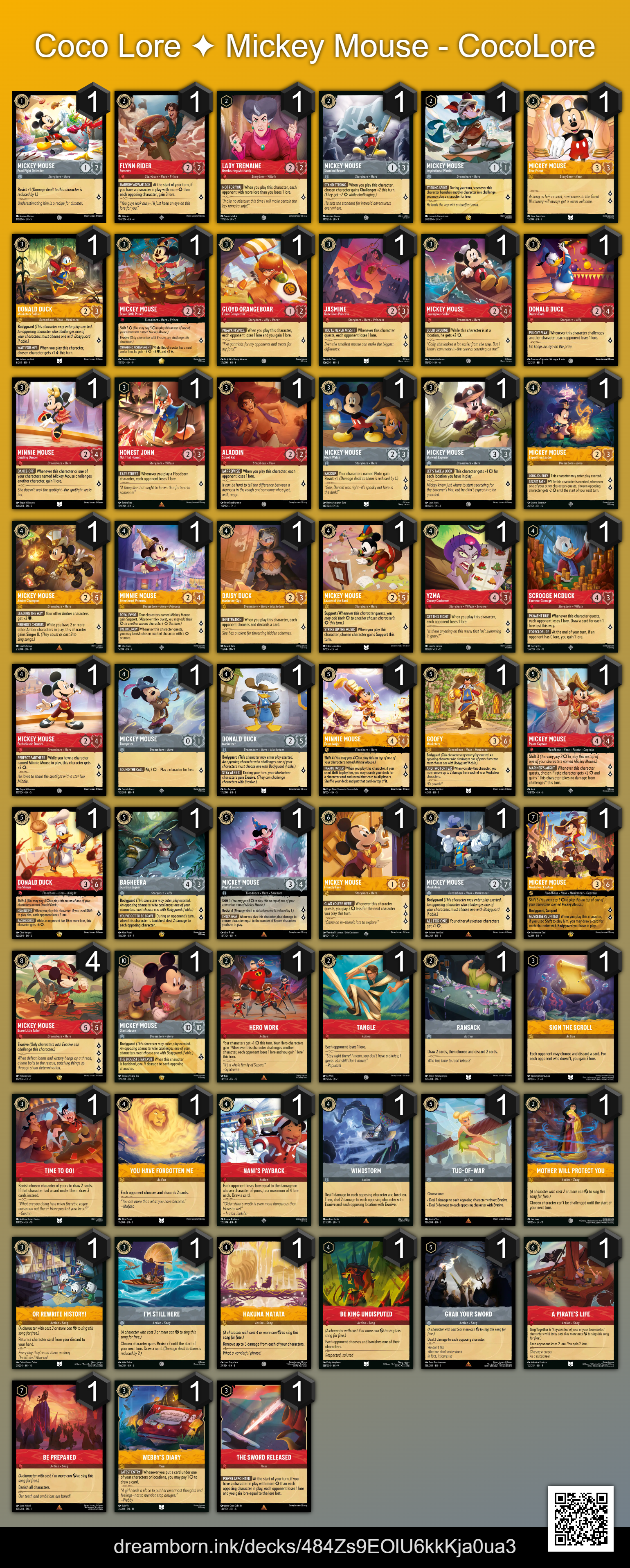
The named card (4). Mickey Mouse — Brave Little Tailor. An 8-drop that costs 2.
The belt (19). Every Mickey in the three inks. The bases: Food Fight Defender (1, Resist +1, the ideal turn-1 play), Standard Bearer (2), Inspirational Warrior (2), then the 3-drops Mickey Mouse — True Friend, Mickey Mouse — Courageous Sailor, Mickey Mouse — Night Watch and Mickey Mouse — Stalwart Explorer. Brave Little Prince is the fifth named card for practical purposes: 3 ink to play, 2 to Shift, and a 5/5 Evasive that quests for 4 as soon as anything is under him. The 4-drops each carry a job: Mickey Mouse — Amber Champion sings for free with two other Amber characters out, Mickey Mouse — Expedition Leader can enter exerted and then shrinks an enemy every time another of your characters quests, Mickey Mouse — Leader of the Band hands out Support, Mickey Mouse — Enthusiastic Dancer gets +2 strength with a Minnie in play. Higher up, Mickey Mouse — Pirate Captain and Mickey Mouse — Playful Sorcerer have printed Shift but always use the coconut’s 2, Mickey Mouse — Musketeer is a 7-willpower Bodyguard, Mickey Mouse — Friendly Face quests for 3 and takes 3 ink off your next character, Mickey Mouse — Musketeer Captain draws a card per Bodyguard you have when Shifted in, and Mickey Mouse — Giant Mouse is a 10/10 Bodyguard for 2 ink whose death deals 5 damage to every opposing character. Mickey Mouse — Trumpeter is the odd one: I explain his job in the game plan.
The Minnies (3). Minnie Mouse — Dazzling Dancer gives a lore each time she or a Mickey of yours challenges. Minnie Mouse — Sweetheart Princess gives your Mickeys Support and banishes an exerted 5-strength character when she quests. Minnie Mouse — Drum Major pays her printed Shift 4 onto one of the other two and puts any character from your deck on top of it.
The shield (5). Donald Duck — Musketeer Soldier, Daisy Duck — Musketeer Spy (each opponent discards on arrival), Donald Duck — Musketeer (your Musketeers gain Evasive on your turn), Goofy — Musketeer (heals every Musketeer), Bagheera — Guardian Jaguar. Seven Bodyguards in the list once you count the Mickeys.
Draw and recovery (6). The Horseman Strikes! draws a card and can banish an Evasive character on the way, and Evasive bodies are the only ones that get to challenge a Shifted Brave Little Tailor or Brave Little Prince. Ransack, I’m Still Here, Scrooge McDuck — Ebenezer Scrooge (each opponent loses a lore when he quests and you draw a card for each, so 3 cards a turn at a full table), Time to Go! (banish one of your own characters to draw 2, or 3 if it had a card under it, which turns a dying base into cards), and Or Rewrite History!: a Mickey comes back to hand and Shifts for 2 again.
The drains (16). Tangle, Hero Work (34 Heroes in the deck), Flynn Rider — Frenemy, Lady Tremaine — Overbearing Matriarch, Aladdin — Street Rat, Gloyd Orangeboar — Fierce Competitor, Jasmine — Rebellious Princess, Donald Duck — Daisy’s Date, The Sword Released, Honest John — Not That Honest, Sign the Scroll, Yzma — Choosy Customer, Nani’s Payback, You Have Forgotten Me, Donald Duck — Pie Slinger, A Pirate’s Life. Fifteen of the sixteen take lore from or cards out of every opponent at once. The named card sings A Pirate’s Life on his own.
Board control (5). Be Prepared, Be King Undisputed, Windstorm, Grab Your Sword, Tug-of-War.
Protection (2). Mother Will Protect You keeps a stack from being challenged for a round. Hakuna Matata heals 3 off every character you have, which matters because a Shifted Mickey inherits whatever damage the base was carrying.
The printed curve is 1 at 1 ink, 8 at 2, 18 at 3, 15 at 4, 8 at 5, 3 at 6, 2 at 7, 4 at 8 and one 10-drop. The printed curve lies: 22 of the 23 Mickeys above 2 ink enter for 2. Twelve cards cannot be inked, and I hold that line as a rule; three of the five Mickey lists I looked at run 19 or more, which is a different risk appetite from mine.
The 4-player game plan
Turns 1 to 4, look harmless. The belt spends 2 ink a turn and puts a 4-lore quester on the board every other turn. That does not look like much. Keep it that way. Do not fire a single drain before you are sitting on 8 to 10 lore of your own.
Turns 5 to 7, spend the other half. This is where the free ink goes. Jasmine, Scrooge and Daisy’s Date are repeatable drains that sit next to the stacks; Tangle, Aladdin, Gloyd and Yzma are 1 lore off everyone with a body attached; A Pirate’s Life is a 2-lore swing against each opponent that the named card sings for free. The table is playing to 25 and every one of these cards moves three scores at once. Hold Grab Your Sword and Be King Undisputed for the turn two opponents have filled their boards.
What the table should do to you, so you know what is coming. The correct answer to this deck is to kill the base before the Shift, not the stack after it. Five of the eight cheap bases die to 2 damage. Food Fight Defender’s Resist helps, I’m Still Here covers the one turn a base is exposed, and Mother Will Protect You covers a finished stack. Play a base and I’m Still Here in the same turn when you can.
Giant Mouse is bait, and that is fine. People will tell you a 10/10 for 2 ink paints a target. It does, and I want them to take the shot. THE BIGGEST STAR EVER triggers on any banish, including a targeted one: whoever removes him hands 5 damage to every opposing character on the table, which is three boards, not one. The one case where it deals nothing is a full board wipe. The trigger still happens, but it resolves after the wipe, and by then there are no opposing characters left to damage. Getting through him in a challenge means beating 10 willpower behind Bodyguard. What actually answers him is bounce or “put into inkwell” effects, and those are scarce.
Be Prepared is the panic button, not the plan. It is symmetric on paper and not in practice: after the wipe you rebuild at 2 ink a body while three opponents rebuild at full price. But a wipe costs you more cards than anyone else, since your stacks are two cards each, and it costs the named card’s quest if he sings it. Two more things I would not count on: the singer is banished by his own song, and Giant Mouse deals no damage under the wipe, because his trigger resolves when every opposing character is already gone. Use it only when someone else is close to closing and you are not. Never when you are ahead, and this deck is usually ahead.
Trumpeter exists for the turn after the wipe. Mickey Mouse — Trumpeter was in all five Mickey lists I looked at, and in the normal game he is strictly worse than the coconut: 4 ink to play, then exert plus 2 ink to put a character into play for free, and that character enters wet and inherits nothing. When you have a base on the board, never spend a turn on him. But Shift needs a Mickey already in play, and after a wipe there is none. Trumpeter is the only card in the list that deploys without a base. Cast him on the reset turn, then Giant Mouse comes in for effectively 6 ink while the rest of the table is on their first 2-drop. He is a plan B card and I keep him only because Be Prepared is in the list.
Politics. For most of the game you are the player with the small board and the 4-lore quester nobody wants to waste removal on. Sweetheart Princess banishing an exerted 5-strength body is a favour you can trade. The discard package (Daisy Duck — Musketeer Spy, Sign the Scroll, You Have Forgotten Me) makes enemies, so use it only after the table already has one.
Where it breaks
Two weaknesses, both measured.
It has no big turn. The belt’s own output is a band of roughly 8 to 12 lore a turn from turn 5 on, and the peak of about 17 needs The Sword Released and Flynn Rider — Frenemy both in play, two single copies with maybe a 6 percent chance of meeting by turn 6. I do not count that. If you want a deck that wins from behind with one enormous turn, this is not it. It never has a big turn. It has the earliest steady one, and the drains make the steady one land on three people.
Targeted removal costs more than it looks. I reran the goldfish with one change: from turn 3 on, at the end of each round, your best stack gets banished with some probability. If the table removes something of yours once every four rounds, your median close slips from turn 7 to turn 8 or 9. If it happens every other round, you are at 13 lore on turn 8 and the deck is not winning. The reason is the same one as above: each stack that dies takes two Mickeys with it, and you see about six a game. That model ignores Evasive on the two best Mickeys, ignores seven Bodyguards, and ignores the fact that at a 4-player table each opponent’s removal is split three ways. So it is a floor, not a forecast. But it tells me the deck’s tier rests on the table not treating it as public enemy from turn 3, and only real games can tell me whether that holds.
Flex slots
Swaps I have already checked against the pool, for tables that drift.
| Out | In | When |
|---|---|---|
| Tug-of-War | The Matchmaker — Unforgiving Expert | Tables where your Mickeys get to challenge; every challenge drains everyone |
| Windstorm | Negaduck — Public Enemy Number One | Same idea with a bigger body and a lore for you |
| Hakuna Matata | Lost in the Woods | Tables that answer stacks with challenges rather than actions |
| You Have Forgotten Me | Prophetic Vision | If discard makes you the target too early; a 2-ink drain with a free action attached |
One card I deliberately do not run: Strength of a Raging Fire, which was in four of the five Mickey lists I looked at on one deck site on August 26. It deals damage equal to the number of characters you have, and this deck has fewer characters than it looks, because a stack is one character. In their wide-board versions it is 6 to 8 damage; here it is 3 to 5, arriving late.
What did I miss?
This build comes from pool analysis and a simulation of the list against the ability text in the app as of August 23, 2026, not from a large sample of live tables. The number I most want checked is the removal one: if you have played Mickey at a table that decided to break the belt early, tell me whether it held. Reworks in this beta land weekly, so treat the verdict as a hypothesis with a date on it.